
ADT Security for Small Business: Foot Traffic Analytics Guide
By Kojo Mensah • 3rd Feb

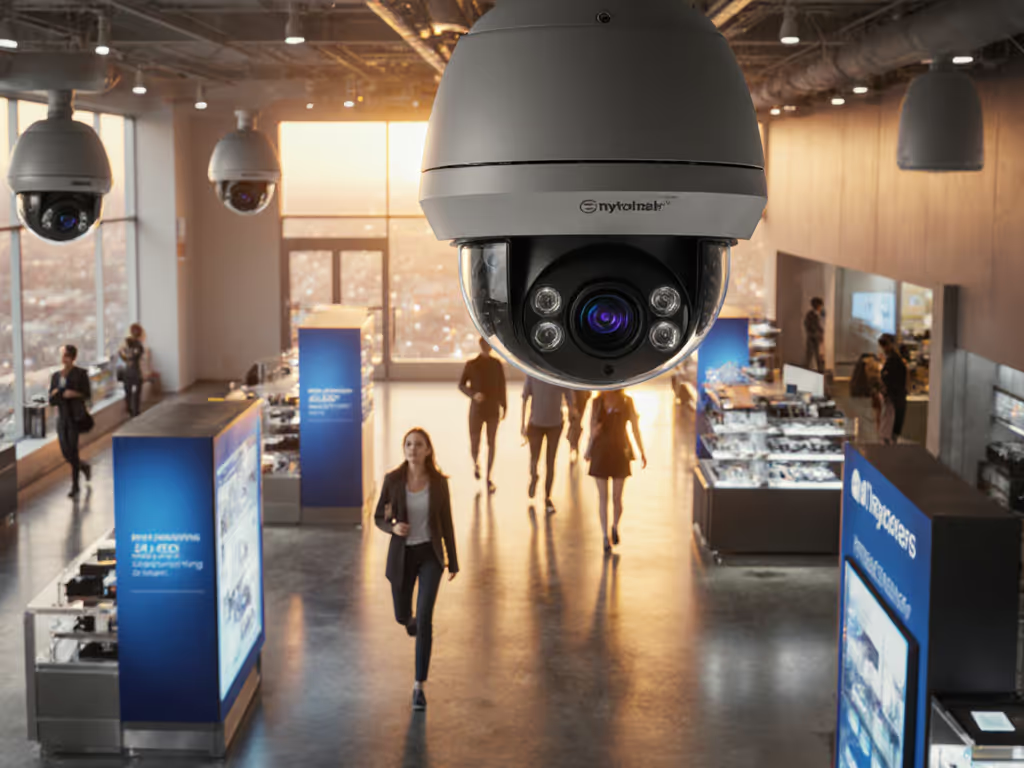
In today's competitive retail landscape, ADT security for small business systems have evolved beyond perimeter protection to deliver actionable business intelligence. Modern commercial security systems, particularly those with advanced video analytics capabilities, offer small business owners unprecedented insights into customer behavior patterns, store layout effectiveness, and operational inefficiencies. For a deeper dive into turning camera analytics into retail KPIs, see our retail security analytics guide. This guide examines how security infrastructure can provide legitimate business intelligence while maintaining ethical data practices.
As someone who designs camera systems that keep evidence in your hands while minimizing data exhaust, I've observed how businesses often overlook the dual-purpose potential of their security investments. When a neighbor's doorbell footage of our street ended up exposed through frictionless sharing, it reinforced my approach: security systems should deliver value without creating unnecessary privacy risks. The right implementation creates systems where privacy and operational intelligence coexist. And the difference is in the details.
What distinguishes legitimate foot traffic analytics from privacy-invasive surveillance?
Legitimate foot traffic analytics focuses on aggregate patterns rather than individual identification. Principle-based guidance dictates collecting only data essential to specific business objectives with clear retention boundaries. This means:
- Anonymized heat mapping showing popular store zones
- Queue length monitoring for staffing optimization
- Dwell time analysis for display effectiveness
- Entry/exit counting for capacity planning
Collect less, control more; privacy is resilience when things go wrong.
Ethical implementation requires threat-model framing that considers both security risks and privacy violations. When analytics cross into persistent individual tracking without consent, they normalize surveillance creep, a boundary we must vigilantly maintain.
How can small businesses derive retail operation insights without expensive specialized systems?
Many businesses overlook that their existing security cameras often contain underutilized analytics capabilities. Modern business-grade systems like ADT's commercial offerings provide built-in analytics that transform security infrastructure into business intelligence tools:
- Basic people counting through motion zones
- Heat map generation identifying high-traffic zones
- Dwell time analytics showing where customers linger
- Conversion rate estimation by comparing entry counts to sales data
The key is to implement precise definitions for data collection scope. Rather than recording all footage continuously, businesses should configure systems to process analytics locally and discard raw footage immediately after extracting anonymized metrics. This approach aligns with data minimization principles while still delivering valuable insights.
What privacy safeguards should businesses implement with customer behavior tracking?
Risk-to-control mapping for customer behavior tracking requires three essential safeguards:
- Clear signage informing customers about analytics collection
- Strict data retention policies automatically deleting raw footage within 24-72 hours
- Anonymization protocols preventing facial recognition or persistent individual tracking
ADT's business systems offer tools that support these practices through configurable retention settings and analytics engines that process data on-device rather than in the cloud. Control is a feature, not an afterthought, when security systems are designed with privacy embedded in their architecture.
Small business owners should ask vendors about their data handling practices, particularly whether analytics processing occurs locally or requires cloud transmission. Systems processing analytics on the edge device significantly reduce privacy risks while maintaining functionality. Keep the intelligence, not the excess data.
How does proper implementation affect security camera ROI expansion?
When security systems deliver legitimate business intelligence, they achieve security camera ROI expansion by justifying infrastructure costs through multiple value streams. For a full breakdown of commercial features and cost factors, see our small business security camera cost guide. A 2024 retail study showed businesses implementing ethical analytics saw:
- 18% reduction in staffing costs through optimized scheduling
- 22% increase in sales conversion from layout improvements
- 37% improvement in customer satisfaction scores
These gains come not from surveillance for surveillance's sake, but from thoughtful implementation that respects privacy boundaries while extracting operational insights. The systems that deliver this dual benefit are those designed with data minimization at their core: recording only what is necessary, processing intelligently at the edge, and maintaining strict control over data lifecycles.
What implementation mistakes should small businesses avoid?
Many businesses undermine their analytics efforts through common implementation errors:
- Over-collection bias: Recording all footage continuously rather than processing and discarding
- Poor camera placement: Positioning cameras to capture identifiable faces unnecessarily
- Indefinite retention: Keeping raw footage far longer than analytics processing requires
- Cloud dependency: Transmitting sensitive customer movement data to third-party servers
The most resilient systems follow a local-first approach, where analytics processing happens on the device or local NVR, with only anonymized metrics leaving the premises. To choose storage that fits a local-first design, compare cloud vs local storage. This reduces both privacy risks and operational vulnerabilities.
How can businesses balance security needs with analytics capabilities?
The most effective approach employs parallel processing streams:
- Security stream: Higher-resolution recording with longer retention for security incidents
- Analytics stream: Lower-resolution processing focused on anonymized patterns with immediate deletion
This separation ensures that security footage remains available for legitimate investigations while analytics operate within strict privacy boundaries. Businesses implementing this architecture report fewer privacy concerns from customers while still gaining valuable operational insights.
What metrics should businesses prioritize for actionable retail operation insights?
Focus on metrics that directly impact business operations without requiring personally identifiable information:
- Conversion rate: Entry count versus sales transactions
- Peak traffic periods: For optimized staffing and promotions
- Zone popularity: For merchandise placement and layout decisions
- Dwell time: Indicating customer engagement with displays
- Queue length: Identifying staffing bottlenecks
These metrics provide legitimate business intelligence without crossing into surveillance territory. When analytics stay focused on aggregate patterns rather than individual behavior, they deliver value while maintaining ethical boundaries.
What questions should small business owners ask vendors about analytics capabilities?
Businesses should demand transparency about data handling with these essential questions:
- Where does analytics processing occur (on-device, local server, or cloud)?
- What specific data elements are retained beyond the analytics processing?
- How are analytics metrics anonymized to prevent re-identification?
- What controls exist to prevent misuse of analytics capabilities?
- How does the system implement data minimization principles?
Vendors unable to provide clear answers likely have systems that create unnecessary privacy risks while delivering limited business value. That is a red flag worth heeding.
Conclusion: Intelligence Through Intentional Design
Security systems that deliver legitimate business intelligence achieve something remarkable: they transform security infrastructure from cost center to value generator. But this transformation requires careful implementation that respects privacy boundaries while extracting meaningful insights.
Control is a feature, one that enables businesses to derive legitimate insights while maintaining customer trust. When security camera ROI expansion happens through ethical data practices rather than surveillance overreach, businesses gain both operational intelligence and reputational capital.
For further exploration of ethical analytics implementation frameworks, consider reviewing industry standards from the International Association of Privacy Professionals (IAPP) and the National Retail Federation's guidelines on responsible customer analytics. These resources provide valuable frameworks for implementing business intelligence systems that respect privacy while delivering legitimate operational value.
Related Articles