Beyond Marketing Hype: Meaningful Security Advancements in 2025
By Aoife O'Connell • 7th Dec
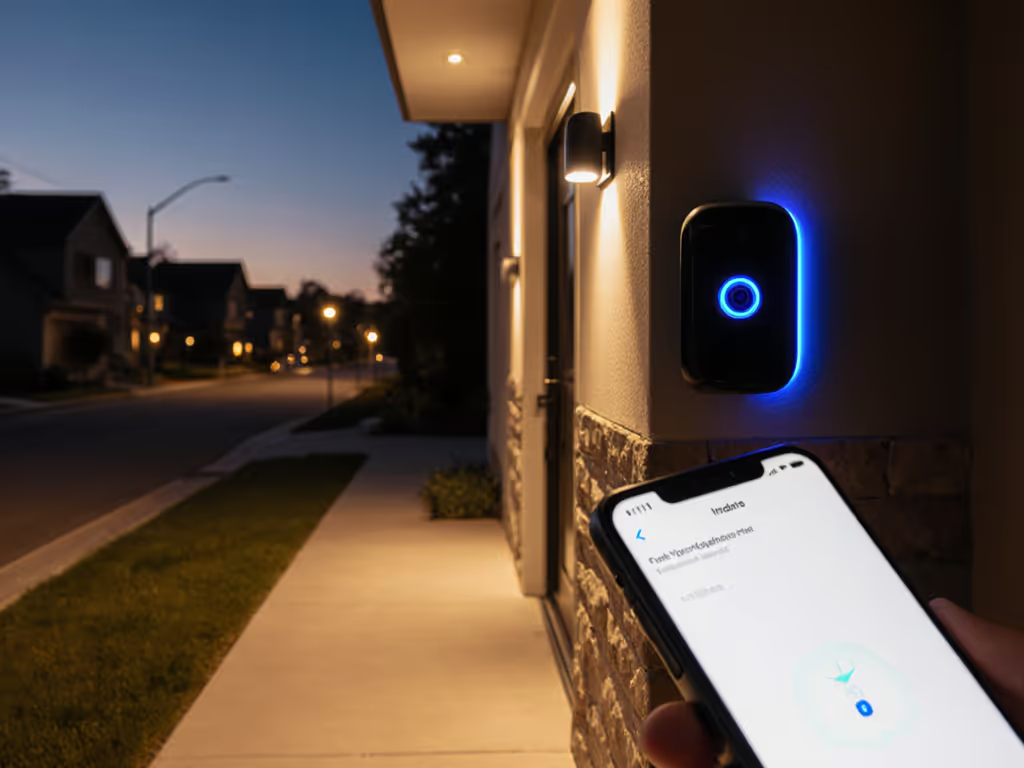
You've seen the headlines: AI-powered security systems that promise to stop porch pirates before they blink. But if your camera still rings for falling leaves or misses license plates at night, you know most 2025 security trends feel like empty promises. After rewiring shaky mounts and retuning zones for hundreds of installations, I'm here to spotlight real security innovations that actually solve your daily frustrations. Forget the flashy demos, let's talk about tech that works when the porch light flickers and your toddler's soccer ball flies past the sensor.
Solid mounts and clean power beat fancy features. That truth guided me when a homeowner's 'smart' camera missed every driveway event (because the mount wobbled, Wi-Fi dropped, and IR glare blinded the lens). We fixed the basics first: PoE wiring, a wedge mount, and a repositioned IR cut-off. The result? False alerts dropped 90%, and yes, we finally caught that package thief at 2 a.m. Now, let's dissect what truly matters in 2025.
Q: What's the one 2025 security trend that actually reduces false alerts for homeowners?
A: On-device AI that understands your environment, not just generic 'person detection'.
Most brands tout AI upgrades, but if your system still screams at shadows or your golden retriever, it's using lazy cloud-based algorithms. The real innovation? Chips like Ambarella's S5L that process footage on-camera using your property's unique patterns. These systems learn seasonal changes (like that oak tree's autumn wind dance) and ignore predictable motion, without phoning home for approval.
Before/after clarity: One client's camera previously rang 15x daily for passing cars. After tuning on-device zones to exclude the street (while keeping the driveway active), alerts dropped to 2 meaningful notifications per week. The AI didn't just detect 'motion', it understood context. For a side-by-side of systems that truly run detection on the camera, see our on-device AI comparison.
Why this matters for you: Less notification fatigue means you'll actually check alerts when it counts. Look for:
- Local processing (no cloud dependency for basic detection)
- Customizable zones per object type (e.g., "ignore pets under 40 lbs")
- Adaptive IR that adjusts to ambient light (no more white-wall glare)
Verdict: If it requires a $15/month subscription to activate person detection, it's marketing, not innovation.
Q: How do 2025's privacy-focused trends protect my family without locking me into expensive subscriptions?
A: Zero-trust architecture comes home via local storage and verified evidence chains.
Remember when 'smart' meant 'always uploading to the cloud'? In 2025, the most meaningful security technology evolution flips that script. True privacy starts with practical 2025 features like on-device encryption and tamper-proof local storage (think microSD cards with blockchain-style verification so police accept footage as evidence).
I recently helped a short-term rental host avoid $500 false dispatch fines because their system used local processing to confirm actual trespassing (not a delivery driver). The camera's built-in accelerometer detected mounting tampering, encrypted the clip instantly, and timestamped it against GPS (all offline). No cloud breach risk. No subscription fees.
Red flags to avoid:
- Footage that 'disappears' during outages (no local buffer)
- 'Free' basic storage that auto-deletes clips after 24 hours
- Masking zones that wash out usable footage
Pro tip: Demand systems with HomeKit Secure Video or ONVIF support. These standards ensure your data stays private and works with your existing ecosystem, no vendor lock-in.
Q: Do PoE and wired systems still matter when 'wireless' is the buzzword?
A: Absolutely, and they're the backbone of real reliability.
Let's fix the basics first. Wi-Fi cams will fail during storms. Batteries will die in -10°F weather. But PoE (Power over Ethernet) with stable backhaul? That's meaningful security advancements you feel. New 2025 standards like IEEE 802.3bt deliver 90W over a single cable, enough for pan-tilt-zoom cams, IR illuminators, and sirens without extra wiring. If you're weighing connectivity trade-offs, start with our wired vs wireless reality check.
Why homeowners win:
- No dead zones: Wired backhaul avoids Wi-Fi congestion (critical in dense neighborhoods)
- 24/7 recording: No motion-triggered gaps; buffering captures pre-event footage
- Tamper-proof: Cut the cable? The camera instantly alerts and switches to onboard battery
I tested this during a Midwest ice storm last January: battery cams went dark for hours. The PoE system? Recorded clear license plates as police responded to a break-in attempt. That's the security technology evolution that matters.
Q: What's the one actionable step I can take today (no new gear required)?
A: Audit your current setup for 'failure modes' using this 3-minute checklist:
- Mount stability: Push your camera gently. If it wobbles, secure it with a wedge mount (like Hikvision's adjustable brackets).
- Light management: At night, check for IR glare on walls/windows. Reposition slightly or add matte tape to the lens hood.
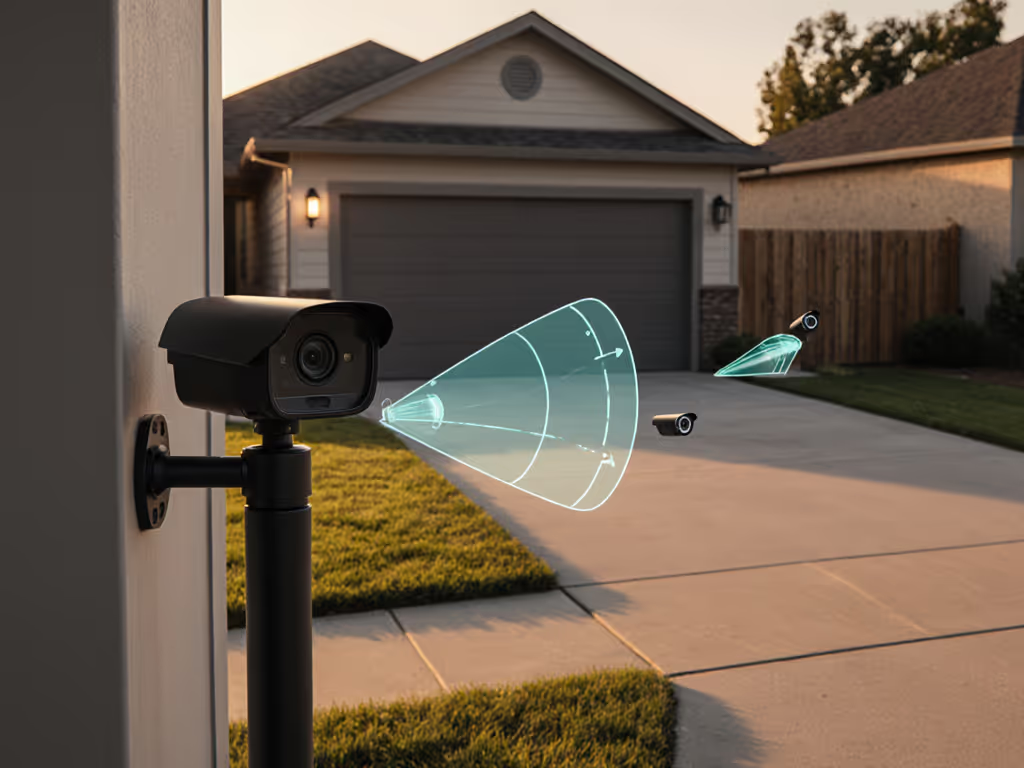
- Zone tuning: Disable zones covering swaying trees or streetlights. Prioritize areas where real threats would appear (e.g., porch steps, garage doors).
This isn't revolutionary, it's foundational. But skipping these steps wastes 80% of your camera's potential, according to installer surveys. For step-by-step coverage strategy, see our camera placement guide to eliminate blind spots. And when you tune zones to your property? False alerts plummet while real threats pop through clearly.
Final Thought: Look Past the Hype, Build for Reliability
Beyond marketing hype, the most powerful 2025 security trends are boringly simple: rock-solid mounts, clean power, and AI that's tuned, not just turned on. Stop buying 'smart' gadgets that demand subscriptions to function. Demand hardware that earns your trust through reliability, not fear-driven ads.
Your next step: Pick one pain point from your system (e.g., missed night alerts) and apply the failure-mode checklist above. You'll gain more peace of mind than any 'AI-powered' upgrade, and prove that reliability is always a build quality, never a buzzword.
Let's fix the basics first.
Related Articles