Multi-Threat Home Cameras Compared: Gas, Water, Fire Detection
By Kojo Mensah • 15th Mar
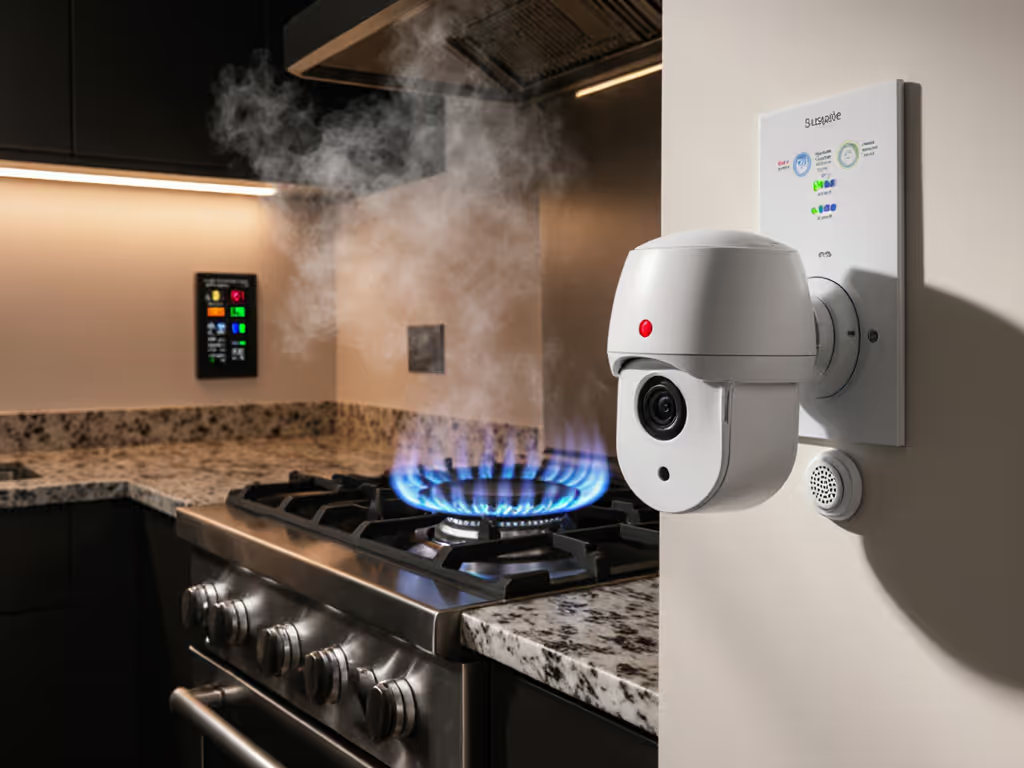
Understanding Environmental Hazard Security Cameras
Environmental hazard security cameras and multi-threat detection cameras sound like a single unified system, but they represent something more nuanced and important: the intersection of traditional security cameras with specialized environmental sensors. Before comparing options, we need to address a critical distinction that most marketing materials gloss over.
A security camera designed for perimeter monitoring, even one with AI-powered person detection and night vision, does not inherently detect gas leaks, water seepage, or early-stage fire. These require fundamentally different sensor technologies: electrochemical cells for gas, capacitive or flow sensors for water, and thermal or smoke detection for fire. The comparison isn't really "camera A versus camera B." It's about building an integrated monitoring ecosystem where cameras play a supporting role in documentation and verification, while specialized sensors handle the actual hazard detection.
This matters for your threat model. Control is a feature, and understanding where each technology sits in your data and risk landscape determines whether you get genuine peace of mind or just the illusion of it.
FAQ: Multi-Threat Detection and Security Cameras
What can security cameras actually detect regarding environmental hazards?
Traditional security cameras, even those with advanced AI, excel at capturing visual evidence after a hazard becomes apparent. A camera might record visible water pooling, smoke, or flames, but it cannot sense a gas buildup before ignition or a water leak developing inside walls.
Some newer security systems integrate visual anomaly detection: algorithms trained on historical footage to flag unusual patterns like water stains appearing over time or discoloration consistent with fire damage. This is reactive verification, not active prevention. According to industry analysis, the rising trend in 2026 is integration of analytics-rich cameras with existing VMS (Video Management Systems) to layer threat detection workflows, but this remains supplementary.[7]
In practice, the most reliable multi-threat setup pairs dedicated environmental sensors, standard off-the-shelf smoke detectors, water leak sensors, and CO/gas detectors, with a security camera as a logging and evidence layer. The sensors trigger alerts; the camera documents the context and aftermath.
How do water leak surveillance and security cameras work together?
Water damage is among the costliest and slowest-detected home disasters. A water leak surveillance integration typically follows this pattern:
- Sensor placement: Capacitive or conductivity-based water sensors sit in high-risk zones: under sinks, near HVAC condensation lines, in basements, around water heaters.
- Alert triggering: When water is detected, the sensor sends a signal to a hub or controller.
- Camera activation: A security camera (often repositioned to frame that area or already in view) begins 24/7 recording or on-demand recording triggered by the alert.
- Timestamp logging: The camera records the exact moment of detection and progression, creating an auditable timeline.
- Cloud or local storage: Evidence is archived for insurance claims or damage assessment.
The critical advantage of this setup is defensibility. When filing an insurance claim or investigating the source of damage, a timestamp-accurate video showing when water appeared and from which direction is invaluable. However, this requires that your camera system stores footage reliably and locally, not in a cloud service subject to outages or data loss. For a deeper comparison, see our cloud vs local storage guide to choose a storage approach that won’t fail during emergencies.
Many homeowners using SimpliSafe or Ring cameras, for instance, pair them with third-party water sensors that integrate via IFTTT (If This, Then That) or home automation hubs like Home Assistant, triggering manual recording or stored clips. The camera isn't detecting water; the sensor is. The camera is a documentary witness.[1]
Can security cameras help monitor fire and smoke?
Security cameras cannot detect smoke or fire before it becomes visible. However, they serve three critical roles in fire safety:
1. Early visual verification: A camera with night vision and wide field of view can catch smoke or visible flames sooner than a human checking periodically. If the camera frames a kitchen or high-risk area, you gain seconds to minutes of advance notice on video, which may help recovery or evacuation decisions.
2. Insurance and forensic documentation: After a fire, video evidence of how the fire started (visible ignition, timing, spread pattern) supports insurance investigations and prevents disputes about coverage.
3. Verification of detector activation: If your smoke detectors fire off an alert at 2 AM, a simultaneous clip from a nearby security camera can confirm whether smoke is actually present or if it was a false alarm. This reduces unnecessary fire department dispatch and associated liability fines.[5]
Again, the camera is not a fire detector. Dedicated smoke and CO detectors remain essential and legally required. But integrated with cameras, they create a layered, auditable record.
What about gas leak detection cameras?
Gas leak detection cameras represent the most misunderstood category in this space. There are thermal imaging cameras that can visualize temperature differentials (useful for detecting hot spots or electrical fires), but these are specialized and expensive, not standard security cameras.
For natural gas, propane, or refrigerant leaks, the only reliable detection method is a dedicated electronic gas sensor, devices that measure concentration of the target gas in ppm (parts per million). These sensors cannot be integrated into a standard security camera without fundamentally changing the hardware.
What can be done: A security camera placed to frame a gas meter, furnace, or propane tank serves as a visual log. If a leak is detected (via gas detector or smell), the camera's footage confirms the time, presence of service technicians, or other contextual events. Some homeowners pair gas detectors with smart home hubs that trigger security cameras to begin recording, creating a linked event timeline.
Collect less, control more; privacy is resilience when things go wrong.
This integration approach is far more practical than waiting for a mythical "all-in-one" camera that detects multiple hazards, which would require miniaturized electrochemical, capacitive, and thermal sensors in a single weatherproof outdoor or indoor device, technically possible but commercially unfeasible at consumer price points.
How do I integrate multi-threat detection with privacy and local storage?
Here's where your threat model and control philosophy intersect. If you rely on cloud-based cameras (SimpliSafe, Ring, Arlo, Nest) with IFTTT or API-based integrations, every sensor trigger, video clip, and timestamp flows through a third-party server. That data is retained, potentially shared, and subject to that company's privacy policy.[4]
A privacy-first multi-threat setup looks different:
- Local NVR (Network Video Recorder): On-premises storage like Frigate (open-source), a Synology NAS, or a dedicated Linux appliance handles all video recording and retention locally.
- Open standards: IP cameras using RTSP or ONVIF protocols, not proprietary cloud-dependent models.
- Sensor hub with local automation: Home Assistant, Node-RED, or a home automation controller processes sensor data locally, triggering recordings and alerts without cloud relay.
- End-to-end encryption: Any alerting sent to your phone uses encrypted channels (Signal, Telegram, or Home Assistant Cloud with encrypted tunneling).
- Retention policy: You define how long footage is kept, days, weeks, or months, based on your actual need, not the vendor's server costs.
This approach costs more upfront (NVR hardware, cameras without subscription plans) but returns control. A neighbor's doorbell footage ending up in a viral group, faces and license plates exposed, that's the friction of cloud convenience without consent. A local setup eliminates that risk vector entirely.
What's the realistic ROI of multi-threat camera integration?
The honest answer: security cameras themselves prevent little. They deter some thieves and document some events, but environmental hazards like gas leaks, water damage, and fire aren't deterred by a camera, they're prevented by maintenance, sensors, and code compliance.
The ROI comes from evidence and insurance. A timestamped video corroborating a water damage claim can mean the difference between full and partial reimbursement. Clear footage of how a fire ignited supports or contests an arson investigation. A camera recording the moment a gas detector triggered helps forensics and prevents false claims.
Recent industry analysis confirms that while false alerts from security cameras create fatigue and noise, systems with on-device AI and integration to verified sensor data significantly reduce nuisance dispatch and liability fines.[6] The cost-benefit tilts toward integration when:
- You already have quality IP cameras in place.
- Specialized sensors (water, gas, smoke) are deployed at risk points.
- Your local NVR or cloud service supports reliable timestamping and clip export.
- Your insurance underwriter recognizes the documentation as credible.
Which camera brands support multi-threat integration best?
No single brand dominates multi-threat detection cameras because the feature set is inherently fragmented. However, cameras that support open APIs, local storage, and flexible automation integrate more readily with environmental sensors:
- Coram PTZ and dome cameras (4MP and 8MP models) emphasize long-range clarity and local integration, useful for monitoring large properties where sensors are spread out and visual verification matters.[3]
- Cameras with ONVIF or RTSP support allow integration into third-party NVRs and automation platforms, decoupling you from a single vendor's cloud lock-in.
- SimpliSafe and Ring systems do offer integrations, but both rely on cloud mediation for multi-device workflows, which carries privacy and latency trade-offs.[1]
For a multi-threat setup prioritizing control, the strongest approach is building around an open NVR platform (Frigate, Home Assistant, or a commercial NAS) rather than choosing a camera first and hoping it integrates later.
What should I prioritize: coverage, detection accuracy, or cost?
This depends on your threat model.
If your concern is post-event forensics (insurance claims, investigation), prioritize coverage and nighttime clarity. High resolution (4K), wide field of view, and reliable night vision ensure that when a leak or fire occurs, the visual record is usable. A 1080p camera in a dark room may fail to show critical details.[3]
If your concern is early warning and deterrence, prioritize sensor integration and alert responsiveness. A fast, reliable water or gas detector paired with a simple HD camera that records locally and triggers notifications in under 5 seconds matters more than 4K resolution.
If your concern is privacy and control, prioritize local storage and open standards over feature count. A 2MP ONVIF-compliant camera feeding into a local NVR with end-to-end encryption is more resilient and controllable than a 4K SimpliSafe camera with cloud-only clips.
Cost-wise, expect to budget $300-$1,200 for a multi-hazard camera setup depending on your approach: A single cloud camera with basic integrations costs $200-$300; a local NVR with 2-3 open-standard IP cameras runs $800-$2,000 upfront but eliminates subscription fees and cloud lock-in.
Designing Your Multi-Threat System
A practical multi-threat home camera system is not a single product category; it's an intentional stack:
- Baseline sensors: UL-listed smoke detectors, CO detectors, water leak sensors, and gas detectors at code-required locations.
- Cameras for context: IP cameras with reliable night vision, 1080p-4K resolution, and integration hooks (RTSP, ONVIF, or open API).
- Local hub: NVR or home automation controller processing sensor alerts and triggering recording.
- Timestamped evidence storage: Local or encrypted off-site backup of clips tied to sensor events.
- Access control: Local app, web interface, or encrypted notification delivery, no forced cloud onboarding.
This design respects your evidence chain, protects your privacy, and ensures that when a hazard is detected, you have an auditable, insurable record, not just a cloud clip you can't verify.
Further Exploration
The landscape of integrated environmental and security monitoring is maturing, but the best solutions are still assembled, not purchased as a single package. Before committing to a camera system, audit your actual hazards: water risk points, gas appliances, fire zones. Source dedicated sensors first, they're cheaper and more effective. Then choose cameras and storage infrastructure that integrate with those sensors rather than replacing them.
Your future self, filing an insurance claim or supporting a forensic investigation, will thank you for the clarity, control, and evidence that thoughtful integration provides.
Related Articles