Environmental Hazard Security Cameras Compared
By Kojo Mensah • 23rd Mar
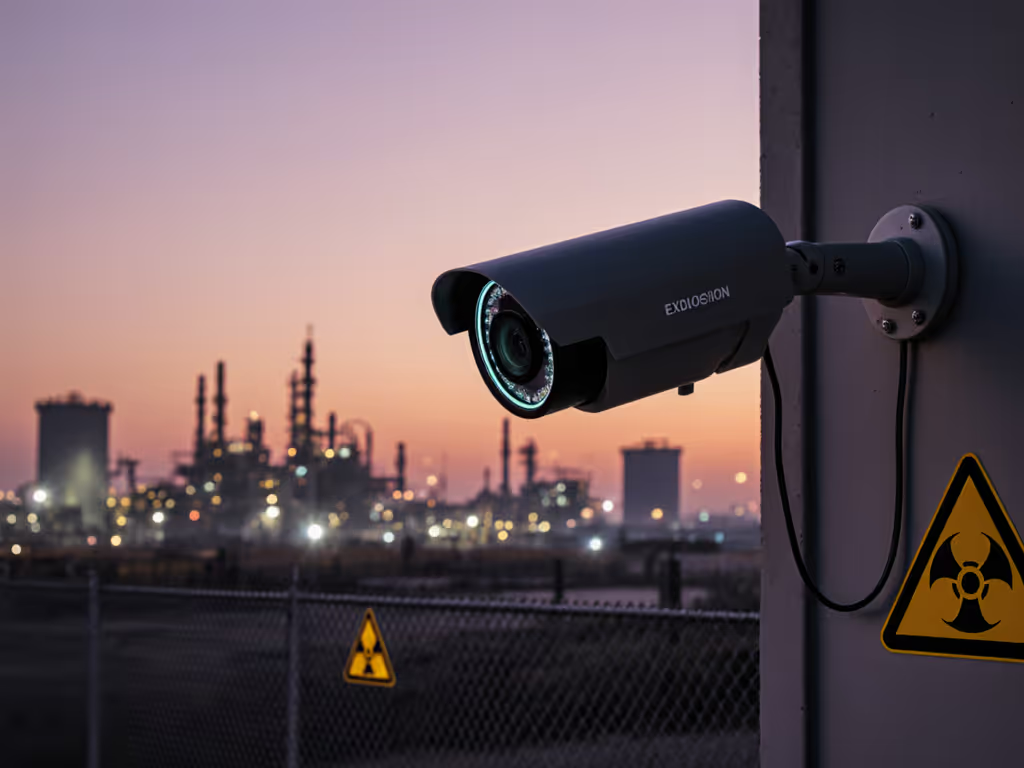
What Counts as an Environmental Hazard Security Camera?
A true environmental hazard camera does more than record in rough conditions - it's engineered to operate safely within explosive, corrosive, or toxic atmospheres without becoming an ignition source. The distinction matters: a weather-sealed outdoor camera handles rain; an ATEX-certified explosion-proof camera can operate in a Zone 1 classified area (where explosive gas mixtures are likely during normal operation) without sparking ignition. If you only need weather and power resilience rather than explosion protection, start with our extreme condition camera guide.
Industry standards highlight five certifications:
- ATEX certification (European): Mandatory for cameras in explosive atmospheres within the EU
- IECEx certification (International): Global equivalent to ATEX, ensuring safety across borders
- UL certification (North America): Underwriters Laboratories; required in U.S. hazardous locations
- IP ratings (Ingress Protection): IP66 or IP67 minimum; indicates dust and water resistance
- Material compliance: Stainless steel or aluminum housings that prevent spark generation and resist corrosion
For homeowners and small-business owners, environmental hazard cameras typically enter the picture when:
- Monitoring oil-heated basements, fuel storage, or propane tank areas
- Surveilling chemical or cleaning supply storage near electrical equipment
- Covering workshops with high dust concentrations or flammable finishes
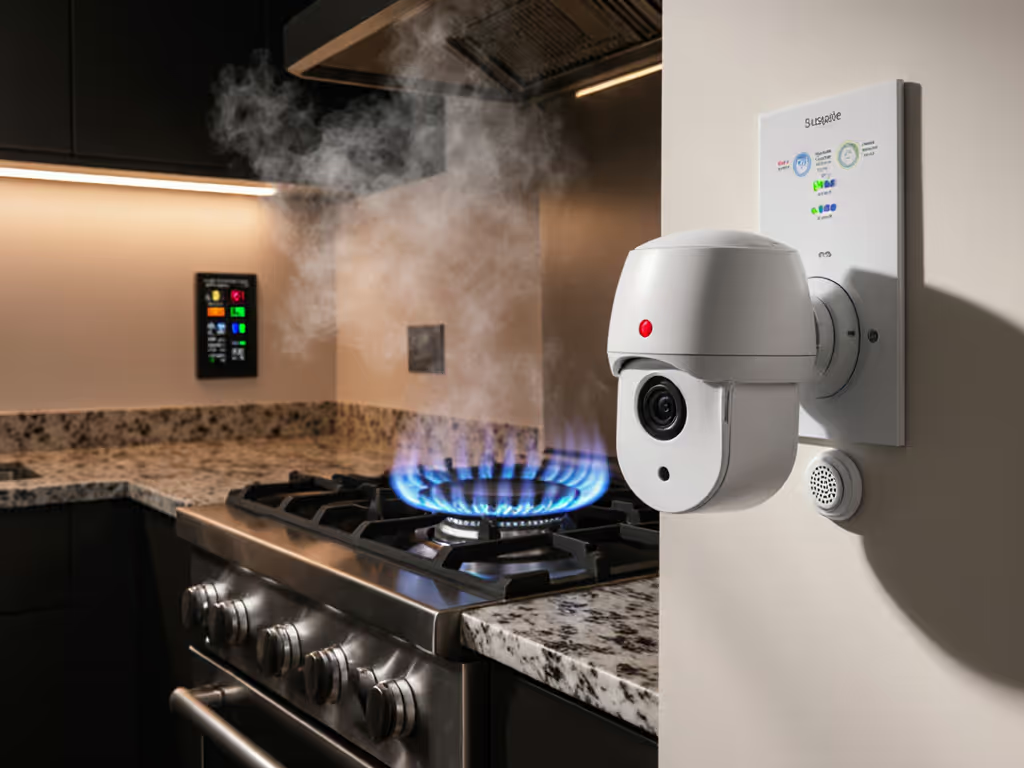
- Protecting utility rooms where gas water heaters or furnaces operate
- Watching industrial-adjacent outbuildings (carports, equipment sheds)
The regulatory trigger often isn't the camera itself - it's the zone classification determined by your local fire marshal or insurance underwriter.
Does My Property Actually Need Explosion-Proof Cameras?
The honest answer: rarely, at the residential scale. Most homes don't have classified hazardous locations. However, you may believe you do, and the confusion is worth untangling.
Zones are defined by the presence and frequency of explosive atmospheres, not the presence of gas alone. A furnace room with a propane water heater is not automatically a Zone 1. It's a Zone 1 only if explosive gas-air mixtures are likely to occur during normal operations - typically meaning a known leak risk, poor ventilation, or repeated historical incidents. Your insurance agent or local authority having jurisdiction (AHJ) makes that call.
What often masquerades as "I need hazardous-area cameras" is actually: "I want tough, reliable surveillance in a damp, corrosive, or high-dust environment." That's IP66/IP67 territory, not ATEX-certified territory. A stainless-steel, IP67-rated industrial camera in your basement costs far less than an ATEX unit, won't require special installation permits, and will deliver the evidence clarity and durability you're after.
The privacy lesson embedded here: Compliance certifications are auditable, time-stamped, and tied to data-handling rules. If your property does fall under hazardous-location regulations, the camera itself becomes a compliance artifact. Its footage retention, encryption, and access logs may be subject to audit or discovery. Knowing your actual zone classification upfront lets you design data retention policies that reduce liability - collect only what you're required to keep, encrypt it locally, and purge it on schedule. Collect less, control more; privacy is resilience when things go wrong.
What Are the Key Differences Between Explosion-Proof and Weather-Sealed Cameras?
| Factor | Weather-Sealed (IP66/IP67) | Explosion-Proof (ATEX/IECEx) |
|---|---|---|
| Typical Cost | $300-$1,500 per unit | $2,000-$8,000+ per unit |
| Regulatory Requirement | None (optional durability upgrade) | Mandatory for classified hazardous areas |
| Certification Scope | Dust and water ingress; temperature range | Explosive atmospheres; spark-free design; material/surface temps |
| Installation | Standard electrical; no special permits | Engineered per hazardous-location code; often requires third-party inspection |
| Data Handling | Flexible (local, cloud, hybrid) | Often mandated: local storage, audit logs, tamper evidence |
| Thermal/IR Imaging | Common add-on | Frequently bundled for low-visibility inspection |
| Recovery After Failure | Replace unit; data may be lost | Unit is evidence; decommissioning may require certification |
A CorDEX ToughPIX DigiTherm, for example, is ATEX Zone 1 & 21 certified and combines thermal and digital imaging, making it ideal for predictive maintenance in explosive atmospheres where temperature anomalies signal impending failure. But for a homeowner's garage or equipment shed without classified status, the certification cost and installation burden bring no ROI.
How Does Data Control Work in Hazardous Environments?
This is where privacy and compliance converge. In classified areas, regulations often mandate local storage or air-gapped systems. Cloud backup for explosion-proof evidence is controversial - if your footage is the proof that an equipment failure caused a fire, that data chain must be unbroken and tamper-evident. Cloud syncs introduce replication, encryption key management, and third-party access: each a liability vector.
Best practice for environmental hazard cameras:
-
Local storage first: Use an on-site NVR (network video recorder) with encrypted drives. This keeps footage under your physical and administrative control. Compliance auditors and insurers prefer this.
-
Encryption at rest: All recordings should be encrypted with a locally managed key, not a vendor-held master key. If the camera or NVR is stolen, the footage remains illegible without your decryption credentials.
-
Retention policies tied to incident windows: In hazard zones, you're typically required to retain footage for 30-90 days post-incident. Define your "incident" clearly (alarm event, maintenance window, inspection date) and prune aggressively. This reduces storage overhead and limits the forensic blast radius if someone gains unauthorized access.
-
Access logs and masking zones: If multiple staff or contractors can review footage, log who watched what and when. Privacy-mask zones where bystanders appear - kitchens, bathrooms, adjacent properties - to comply with data minimization principles and avoid creep.
-
Tamper alerting: Explosion-proof systems often include checksums and signed timestamps. Any modification to footage metadata or gaps in timestamps should trigger an alert. This proves to regulators that your evidence chain is clean. For systems that make tampering provable end-to-end, explore blockchain-verified footage.
I've seen the damage that frictionless sharing can inflict. A neighbor's doorbell recorded our street, and within hours the footage was in a group chat: faces, license plates, package deliveries - all contextualized with speculation and rumor. No malice, just low friction. I rebuilt my setup around the opposite principle: local NVR, per-camera encryption, strict retention. The result wasn't just peace of mind; it was fewer leaks, simpler compliance, and evidence that actually held up when needed. Control is a feature.
What Detection Methods Work Best in Hazardous Areas?
Traditional motion detection fails in harsh environments. Dust, steam, thermal shimmer, and IR reflections all trigger false alarms. Modern multi-threat detection cameras use on-device AI to distinguish between people, vehicles, animals, and environmental artifacts.
For hazardous-area deployment:
- Thermal imaging: Detects temperature anomalies (hot spots on electrical panels, runaway conveyor bearings) and works in zero-light and high-particulate conditions. Ideal for fire hazard monitoring systems.
- Dual-mode (thermal + RGB): The CorDEX and FLIR models merge thermal data with standard imagery, letting operators spot both the anomaly and its context. A hot electrical junction and visible arcing - that's actionable.
- AI-powered person/vehicle detection: Reduces nuisance alerts from shadows and wind-blown debris. Particularly useful if camera is in a non-classified zone but monitoring an adjacent classified area.
- Gas leak detection cameras: Specialized LWIR (long-wavelength infrared) sensors can visualize leaking gas plumes invisible to human eyes. Expensive ($10,000+), but for oil & gas or chemical plants, the ROI is immediate - you spot leaks before they reach ignition sources.
- Multi-spectral fusion: Some military-grade systems layer visible, thermal, and UV data to detect anomalies no single spectrum reveals. Overkill for most SMBs, but emerging in retrofit kits.
The catch: all on-device AI models have false-negative rates. A person crouched low, partially obscured, or in extreme lighting may be missed. AI reduces nuisance alerts but doesn't eliminate them. Pair detection with water leak surveillance integration (moisture sensors in crawl spaces, sump pits, or near HVAC drains) and hardwired temp/humidity probes. Cameras corroborate; sensors trigger.
What Storage and Retention Strategy Minimizes Risk?
For homeowners and small businesses, the temptation is unlimited cloud recording. It's frictionless until a breach, a vendor outage, or a regulatory request forces you to admit you've been storing footage you didn't actually need. To choose a storage model that survives outages and audits, see our cloud vs local storage comparison.
A principle-based approach:
-
Define your threat model first: What incident are you guarding against? Package theft (7-day retention), occupancy verification (14 days), proof of maintenance work (90 days), fire investigation (6 months). Each has different retention math.
-
Local NVR with redundancy: A two-drive RAID-1 system (mirrored) keeps backup on-site. If one drive fails, you don't lose the archive. Encryption keys are stored in a hardware module or a password manager under your control - not in the cloud.
-
Tiered pruning: High-resolution footage for active alerts (7 days); lower-res or sub-sampled streams for cold storage (30-90 days). Motion-triggered clips archive immediately; continuous streams are transcoded downward.
-
Air-gap sensitive data: If you're in a Zone 1 area and footage is compliance-critical, keep the NVR on an isolated network. USB export for authorized review; no internet connection. This eliminates remote compromise vectors and gives you a clean answer to "Has this been exfiltrated?" (No - it was never on the internet.)
-
Scheduled purge with audit trail: A cron job deletes footage older than your retention window and logs the deletion. If a regulator asks why footage from date X is missing, you can prove it was intentional, on schedule, and per policy - not tampering.
This approach - collect less, retain on schedule, encrypt locally - serves dual purposes: it improves your legal posture (you're not a flying target for discovery requests) and it protects privacy (fewer people have access, fewer reasons to store, fewer vectors to exploit).
How Do You Handle Multi-Camera Systems in Hazardous Areas?
Large facilities - refineries, chemical plants, data centers - often deploy 20+ cameras across multiple zones. The architecture must separate concerns.
Zoned architecture:
- Zone 1 & 2 cameras (ATEX/IECEx): Feed encrypted, time-synced streams to a central NVR via hardwired, shielded PoE cable or industrial Ethernet (RS-485, fiber optic). No Wi-Fi in classified areas - it's a spark risk and a security nightmare.
- Non-classified area cameras (standard IP66/IP67): Can use Wi-Fi or hybrid wired/wireless, but still encrypt and log access.
- Unified timeline: NVR synchronizes all clocks via NTP over a segmented network. If an incident occurs at 14:37 UTC in Zone 1, you see correlated events across all cameras at precisely that moment.
For smaller deployments (home or SMB with 2-4 cameras):
- Use a single local NVR (fanless, DIN-rail mounted if possible) in a non-hazardous location.
- Wire hazardous-zone cameras back to the NVR via labeled, continuous conduit. Label every run; document every connection. This speeds troubleshooting and ensures compliance inspectors can verify the installation.
- Backup the NVR config and encryption keys to an encrypted USB drive stored off-site or in a physical safe. If the NVR fails, you can restore quickly without data loss.
What Standards Guide Site Design and Installation?
If your property is classified, installation isn't a DIY task. Codes vary by jurisdiction, but common frameworks include:
- NFPA 70 (National Electrical Code, NEC) in North America: Articles 500-505 govern hazardous locations. Your electrician must be NEC-certified for the specific class/division.
- EN 60079-14 (ATEX design of electrical installations) in Europe: Specifies segregation, cable routing, temperature limits, and documentation.
- API RP 500 / API RP 505 (American Petroleum Institute): Industry guidance for oil & gas sites; often stricter than code minimum.
Installers must provide "Certificate of Compliance" or "Test Reports" showing the camera, enclosure, wiring, and conduit meet certification standards. These become part of your compliance file.
For non-classified environments, standard installation applies, but best practices remain:
- Position cameras to minimize glare and IR bounce-back. Avoid pointing directly at reflective surfaces or porch lights.
- Use a PoE injector or PoE switch on the non-hazardous side of the installation, not inside a classified zone.
- Plan conduit runs to avoid vibration sources (compressors, pumps), which degrade video quality and cause connector fatigue.
- Install a UPS (uninterruptible power supply) to buffer brief power losses. If a power dip cuts the NVR, you lose the instant before the incident - the very moment you need it most.
What Role Does Vendor Lock-in Play?
Many surveillance vendors use proprietary compression, cloud-only features, or encrypted recordings that only their app can decrypt. In hazardous-location contexts, this is a red flag.
Why it matters:
- If a vendor goes bankrupt or discontinues your camera model, you lose access to archived footage.
- If the vendor is acquired and new owners change the encryption scheme, your historical data becomes orphaned.
- If you need to export footage for legal proceedings, proprietary formats may not be accepted by courts or insurers.
Mitigation:
- Prioritize cameras that output standard formats: H.264/H.265 video, RTSP (Real Time Streaming Protocol), ONVIF (Open Network Video Interface Forum). This ensures third-party software - VLC, FFmpeg, other NVRs - can read your recordings indefinitely.
- Encrypt the file, not the container. Use LUKS or VeraCrypt to encrypt the NVR's storage drives. The video file inside remains standard and portable.
- Document the encryption key scheme and store the master key in a separate, offline location. If you need to hand off the system to a new operator or migrate to new hardware, the key must be recoverable without vendor assistance.
This isn't paranoia; it's resilience design. Your footage is evidence and compliance proof. It must outlast vendors.
What Should You Explore Next?
If you've landed here asking whether you need environmental hazard cameras, start with one conversation with your insurance agent or local AHJ. A five-minute call confirms whether your property is in a classified zone. If it is, you're entering regulated territory; hire a certified installer and let the code guide you. If it isn't, you're choosing rugged durability, not compliance - and that's a simpler, cheaper path.
Next, map your threat model: what's the incident you're guarding against, and how long do you need to keep proof? Once you've answered that, you can right-size storage, set retention policy, and avoid the default (cloud forever) that creates data liability without benefit.
Finally, test the NVR and camera interface before full deployment. Can you scrub timelines smoothly? Does the export format work with your playback software? Is the encryption key recovery process documented and practiced? Small friction now prevents panic later.
The cameras that deliver real value aren't the flashiest or the most cloud-dependent. They're the ones that put footage and control firmly in your hands - encrypted, local, and on a schedule you designed.
Related Articles