Bosch DIVAR IP 7000: Enterprise Platform ROI Breakdown
By Marisol Gomez • 7th Mar
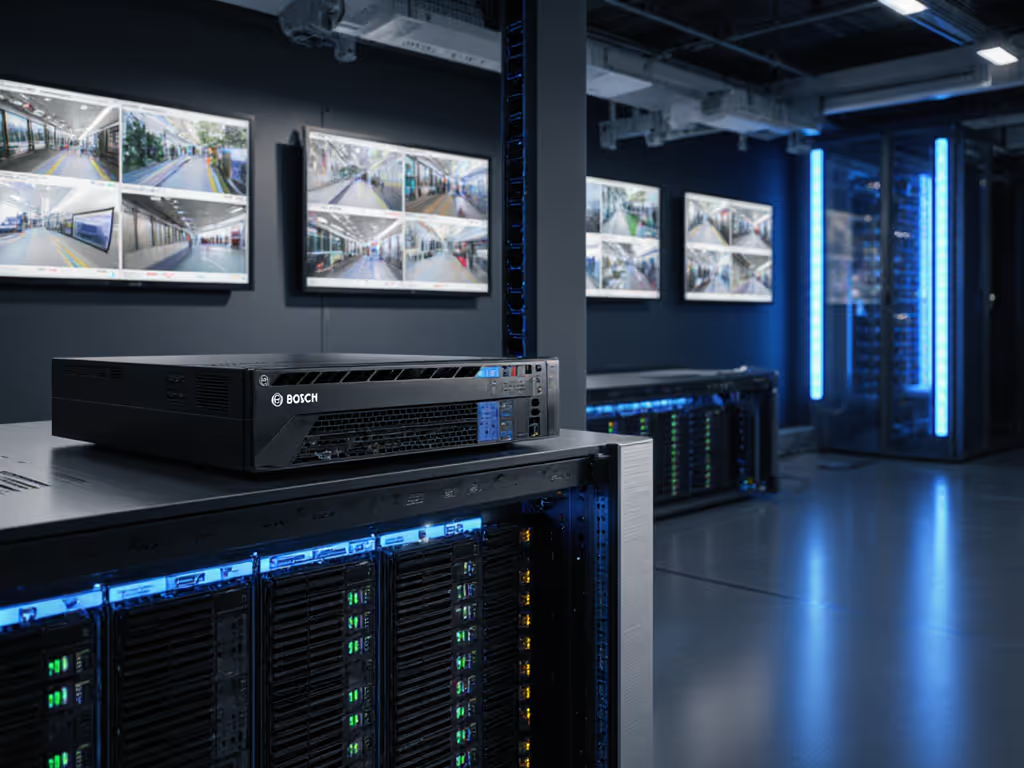
When a client walks into my office asking about Bosch DIVAR IP 7000 review or enterprise video management system platforms, they usually lead with one of two assumptions: either "this is industrial-grade, so it must cost less per incident," or "it's expensive upfront but will save money long-term." Both can be wrong if you don't map the true cost curve.
The DIVAR IP 7000 series is a legitimate enterprise appliance (purpose-built) for facilities and small to medium operations that can't tolerate cloud-only workflows or vendor lock-in. If you're weighing architectures, our cloud-native vs hybrid security comparison explains outage risks, scalability, and costs. But "enterprise-grade" doesn't automatically mean smart spending. I've seen organizations overpay for redundancy they don't use and underpay attention to the parts that actually fail. This breakdown separates marketing from math.
The Problem: Hidden Costs in "All-in-One" Systems
Most security platforms obscure their true cost of ownership. A cafe owner once asked me why their three budget cameras (bought at $100 each) had cost them nearly $3,000 over two years. Every quarter brought a new subscription tier ($15/month per camera), batteries that died in winter, SD cards that corrupted, and a doorbell that disconnected whenever their WiFi hiccuped. If WiFi instability is your pain point, see our wired vs wireless reliability guide. By the third year, they'd spent more on replacements and fees than on hardened infrastructure.
Enterprise systems promise to fix this. They consolidate recording, eliminate per-camera subscriptions, and lock in predictable hardware costs. But the promise is only as good as the design. You still face decisions: What storage do you actually need? Will power redundancy sit unused, or prevent a catastrophic recording gap? Can you truly avoid vendor lock-in, or does the system's software ecosystem pull you deeper?
The DIVAR IP 7000 claims to solve these problems with an integrated security platform approach: centralized recording, pre-integrated software, redundant power, and scalable camera channels. Let's test that claim against real cost scenarios.
The System: What You're Actually Buying
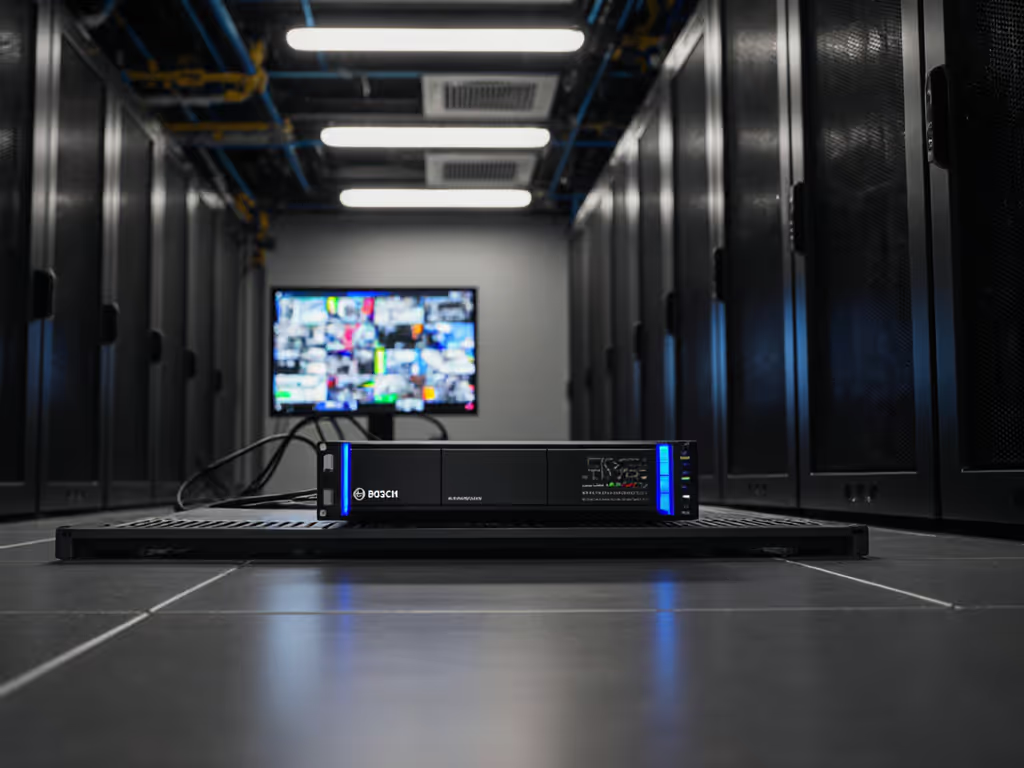
The DIVAR IP 7000 family comes in two main configurations: a 1U rack-mount unit (up to 8 TB storage) and a 2U unit (up to 24 TB storage). Both feature hot-swap redundant power supplies rated for 88-94% efficiency, depending on input voltage and load. The hardware is built on an Intel Xeon processor with dual Gigabit Ethernet ports, and the system supports up to 256 concurrent IP cameras (including 8 sessions for live playback) under the Bosch Video Management System (BVMS).
Here's what that means operationally: you're buying a physical appliance you control locally. No mandatory cloud recordings, no per-camera licensing fees, no surprise tier upgrades. Recording bandwidth caps out at 550 Mbit/s, which translates to roughly 8-12 high-bitrate HD streams simultaneously, or 30+ standard-definition feeds. Hard drives are front-swappable SATA-3 units in RAID-5 or RAID-6 configurations (with fault tolerance built in), and the system operates on 100-240 VAC with automatic failover if one power supply fails.
That's the appeal: a black box that does one job (local video recording) and does it without SaaS parasites.
Total Cost of Ownership: The Math That Matters
Let's work through a realistic five-year scenario for a small commercial property: a retail location with 16 cameras (HD, 30 fps), requiring three days of storage buffer.
Scenario 1: DIVAR IP 7000 2U with 8×4TB drives (32 TB gross, ~21 TB usable in RAID-5)
Initial hardware cost: Roughly $3,500-$4,200 (unit + installation). Hard drive refresh every 3 years (enterprise-rated drives cost $100-$150 per TB): $1,600-$2,000 per refresh cycle. Electricity: the 2U consumes approximately 280-330 watts under load, depending on input voltage and drive activity. At $0.12/kWh (US average), that's ~$290/year. Five-year power total: $1,450.
Replacement parts and maintenance (PSU cleaning, thermal compound, occasional drive replacement): ~$800 over five years.
Five-year total: $7,450-$8,450. Cost per verified incident (assuming 20 incidents per year): $74-$85 per alert.
Now compare to a hybrid cloud model: entry-level enterprise VMS ($2,000) + 16 cloud camera subscriptions ($20/month each = $3,840/year) + local NAS backup ($1,500) + network bandwidth overhead.
Five-year total: $24,000+. Cost per verified incident: $240+.
Subscriptions multiply quietly; math keeps you safe over time. The gap widens if your facility grows. Adding a 17th camera to the DIVAR is a license-free software reconfiguration, while cloud models charge per-device licensing.
Reliability: The Redundancy Test
Where the DIVAR IP 7000 shines, and where skepticism is warranted, is redundancy.
The dual hot-swap power supplies with 88-94% efficiency ratings mean the unit can survive a single PSU failure without dropping a frame. That's genuine enterprise design, not theater. But redundancy only matters if it's tested and monitored. I've audited facilities that paid for dual PSUs and never confirmed that failover actually worked until the day one failed and nobody noticed the second one had been offline for months.
The RAID-5 configuration (standard) protects against a single drive failure; RAID-6 (optional) protects against two simultaneous failures. Both are appropriate for mid-scale operations. However, RAID is not a backup. If ransomware or malware corrupts the storage pool, redundancy won't save you. You still need offline archival of critical footage, a cost that DIVAR proponents often skip in their pitch. To protect NVRs from malware and reduce blast radius, follow our enterprise hardening guide against ransomware.
True reliability cost for a five-year cycle: add $2,000-$3,000 for external archive storage and a documented backup procedure.
Performance Under Load: What Matters and What Doesn't
The 550 Mbit/s bandwidth ceiling is real. For a facility with 16 HD cameras at 4-6 Mbps each, that's comfortable headroom. For a large retailer trying to push 40+ high-bitrate streams to the same appliance, you'll hit limits. The system supports up to 256 cameras, but that's a soft concurrency limit. You can connect that many devices, but sustained recording bitrate is separate.
In practical terms: if your facility can keep total recording load under 400 Mbit/s, the DIVAR 2U will never stall. Once you cross that, you're either dropping cameras, reducing bitrate, or buying a second unit.
Energy consumption is efficiency-honest. The 2U with eight 4TB drives running at full utilization consumes approximately 330 watts at 120V input and 325 watts at 240V input, a 5-8 watt variance that reflects real power-delivery losses. For a facility operating 16 hours daily, that's roughly $360/year. For 24/7 operation, $630/year. It won't break a budget, but it's not negligible for a five-year horizon.
What matters more is the lack of fan noise. Bosch DIVAR appliances run quiet (typically 40-50 decibels) because the redundant PSU design doesn't demand aggressive cooling. That's a hidden win for facilities where the NVR sits in a shared utility room or office area.
Vendor Lock-In: The Real Limitation
Here's where I pump the brakes. The DIVAR IP 7000 is a VMS enterprise platform that locks you into Bosch BVMS software and Bosch-qualified hardware. Can you use ONVIF or standard IP cameras? Yes, with limitations. Bosch's Video Content Analysis (VCA) features, like smart detection and analytics, only work natively on Bosch cameras. Third-party ONVIF cameras record but lose the AI smarts.
That's not evil; it's standard for enterprise systems. But it means your five-year investment is semi-portable. If you want to migrate to a different VMS vendor in year four, you can export footage (standard formats), but all your zone configurations, detection rules, and analytics workflows are BVMS-native.
For a small operation, that's acceptable friction. For a multi-site organization, it matters. You're not truly avoiding lock-in, you're locking in to Bosch instead of a cloud vendor, which is a trade-off, not a victory. To minimize future friction, design around ONVIF interoperability and open-platform components where possible.
Integration Reality: Commercial Video Analytics Performance in Context
The selling point is an all-in-one integrated security platform. The DIVAR 2U runs Bosch's entire BVMS stack: Video Recording Manager (VRM), system monitoring, event management, and optional access control bridging. If you buy eight Bosch turret cameras with built-in video analytics, like person/vehicle detection, intrusion, or loitering, those alerts feed directly into BVMS without third-party API delay. For a deeper look at how analytics cut noise, read our Video Content Analysis guide.
That's faster than cloud-relay systems. But "faster" is relative. An 8-camera Bosch setup with native analytics still has 500-1,000 ms latency from event-to-notification due to software processing, not hardware limits.
For access control surveillance integration, the DIVAR can link to Bosch access control systems (BIS readers, electrified locks) so that a door-badge event triggers synchronized video clip capture and vice versa. But the friction is real. Integrating non-Bosch access control requires middleware or manual log correlation. Again, not impossible, but the all-in-one promise softens if you're mixing vendors.
Scenario Outcome: When DIVAR 7000 Wins
The DIVAR IP 7000 2U is the right fit when:
- You operate a single facility (retail, office, warehouse) with 10-30 cameras and own or control the network infrastructure.
- You need local recording without mandatory cloud contingency and your internet reliability is adequate for remote viewing but not critical for recording.
- You want to avoid per-camera licensing and monthly subscription tiers indefinitely.
- Your IT team or integrator is comfortable managing Linux-based appliances and can field-replace drives and PSUs.
- You can commit to a five-year lifecycle and amortize the $8,000-$10,000 all-in cost.
- You're willing to use Bosch cameras to unlock native analytics and reduce system complexity.
Cut noise, keep outcomes. The DIVAR's strength is doing one thing (local, redundant recording) without distraction.
When DIVAR 7000 Falls Short
The system is overkill if:
- You have fewer than 4 cameras and can accept cloud recording with solid backup discipline (e.g., Wyze + local NAS).
- You operate multiple sites and need centralized cross-facility analytics; a distributed cloud VMS handles that transparently.
- You require 24/7 remote accessibility and your internet is unreliable; you need geographic redundancy (impossible with a single on-prem appliance).
- Your IT staff is absent or outsourced; you need a SaaS platform with vendor-managed uptime SLAs.
- You need seamless HomeKit, Alexa, or Google Home integration; BVMS doesn't natively speak those languages (third-party bridges required).
Final Verdict: Math Over Marketing
The Bosch DIVAR IP 7000 is one of the few enterprise platforms that genuinely reduces long-term cost-per-incident compared to cloud-heavy alternatives, if you operate in the 10-40 camera sweet spot and your facility can tolerate local infrastructure management.
The five-year cost picture is honest: $7,500-$10,000 all-in (hardware, power, refreshes) versus $20,000-$30,000 for equivalent cloud coverage. That math holds as long as you don't treat redundancy as "set and forget" and you build offline archival into your maintenance plan.
The caveat is vendor semi-lock-in and the requirement for competent local IT support. If that's a weakness in your organization, no DIVAR math will save you from the operational risk of a failed disk and no backup.
For property managers, retail operators, and facilities teams: the DIVAR IP 7000 2U is worth a detailed TCO comparison against your current cloud spend. Run the numbers, assume three-year drive refresh and two-year power supply longevity, and track the electricity bill for six months. If your total five-year projection is under $10,000 for the hardware lifecycle, the DIVAR beats the subscription trap. If it's over $15,000, you may be over-specced, and a smaller 1U unit or a different architecture entirely makes sense.
Good security is efficient security. The DIVAR IP 7000 delivers that promise, not because it's Bosch, but because its cost structure aligns outcomes (verified incidents) with what you pay. That's the spreadsheet that matters.