How Behavioral Analytics Detect Suspicious Activity
By Naomi Feld • 2nd May

Behavioral analytics security cameras and anomaly detection home security systems operate on a principle that goes beyond simple motion triggers: they learn what normal looks like, then flag what doesn't. Unlike traditional motion sensors that fire on any movement (a windblown branch, a pet, headlights sweeping across the lawn), behavioral analytics creates a contextual model of expected activity and surfaces only genuine deviations. For homeowners and small-business owners managing property security, the distinction matters deeply. Clarity plus context turns video into evidence when minutes matter most.
Understanding Behavioral Analytics in Physical Security
Behavioral analytics in the security camera context involves studying the patterns and tendencies of activity around your property. Rather than reacting to every pixel change, these systems establish what a normal day, night, or season looks like (delivery trucks arriving at expected times, family members coming home, pets moving through spaces), and then identify activities that break that pattern.
The process rests on three foundational elements: baseline establishment, real-time anomaly detection, and contextual assessment. A system watches network traffic, user activity, and environmental patterns over time, gradually building a profile of ordinary behavior specific to your property's geometry, lighting, traffic patterns, and occupant routines. Once that baseline is locked, deviations become visible.
This approach addresses a critical pain point: alert fatigue. For a deeper dive into how intelligent video analysis filters noise, see our Video Content Analysis guide on reducing false alarms. Traditional motion-based systems generate notifications constantly (rain, insects, shadows, passing cars), leaving owners either ignoring alerts entirely or spending hours manually scrubbing footage for actual threats. Behavioral analytics substantially reduces that noise by distinguishing between expected and unexpected activity.
Building and Maintaining the Behavioral Baseline
Before a camera can detect what's abnormal, it must establish what's normal. This happens through an initialization period (typically one to four weeks) during which the system observes and records typical activity patterns without triggering alerts.
During this phase, the system collects data on:
- Time-of-day patterns (when people, vehicles, and delivery personnel typically arrive)
- Environmental conditions (lighting, weather, seasonal changes)
- Recurring visitors or vehicles (neighbors, mail carriers, service providers)
- Pet movement patterns and zones
- Shadows, reflections, and landscape movement at different times
- Vehicle parking positions and dwell times
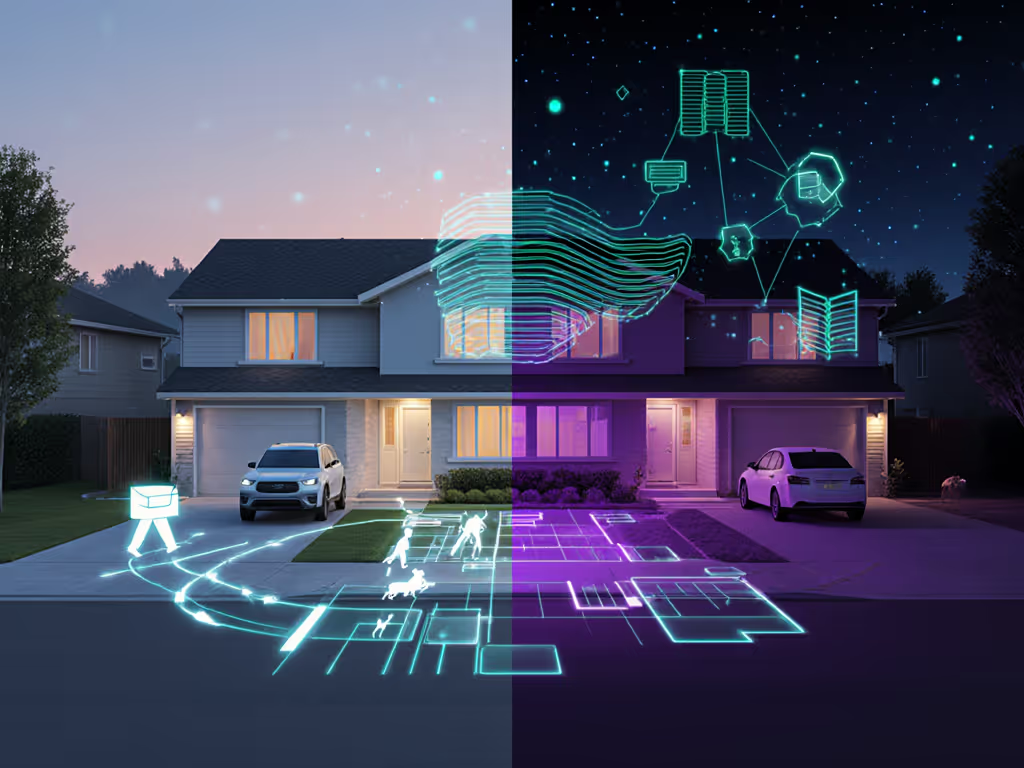
Once a behavioral baseline exists, the system can flag deviations. However, baselines are not static. Legitimate changes occur: a family member gets a new car, you hire a contractor, a neighbor moves away. Effective behavioral analytics systems allow for baseline adjustment or "retraining," ensuring the model remains accurate without losing its ability to detect genuine anomalies.
Real-Time Anomaly Detection and AI Behavior Modeling
With a baseline established, the system evaluates incoming activity in real time, looking for patterns that deviate from the baseline in meaningful ways. This is where AI behavior modeling becomes essential.
Machine learning algorithms can process multiple data streams simultaneously (video frames, metadata about object classification, temporal patterns, and environmental context), far faster and more consistently than rule-based systems. An AI-driven system can recognize not just "a person appeared," but:
- Is this person's trajectory and dwell time consistent with a known visitor or delivery pattern?
- Are their movements erratic or deliberate? (Someone pacing nervously before entering a door differs from someone walking purposefully to a known address.)
- Are they interacting with specific property features (doors, windows, vehicles) in ways that deviate from baseline?
- What is the time-of-day context? (A vehicle arriving at 3 a.m. at a residential address has different significance than the same vehicle arriving at 3 p.m.)
These multi-dimensional assessments reduce false positives substantially. A neighbor walking past consistently registers as background noise. A stranger pausing at your front door at midnight registers as a genuine anomaly.
Applications for Home and Small-Business Security
Behavioral analytics serves distinct use cases in residential and small-business settings:
Detecting unauthorized access attempts: Systems flag people lingering near entry points, manipulating locks, or testing doors in ways that deviate from normal delivery or household patterns.
Identifying suspicious activity patterns: A vehicle parked in an unusual spot, a person surveying the property repeatedly, or someone attempting entry during known absence hours all trigger investigation-level alerts.
Protecting against package theft: Once a baseline for delivery patterns is established, the system can distinguish between a carrier placing a package and a person arriving specifically to retrieve it, which is crucial for evening hours when lighting and motion are harder to parse reliably.
Monitoring critical zones: Behavioral analytics allows contextual threat assessment by region. Motion in a master bedroom during sleep hours carries different weight than motion in a mailbox area; zones can be weighted accordingly.
Building forensic clarity: When an incident occurs, having a baseline means investigators can identify exactly when normal activity stopped and abnormal activity began. This timestamps evidence with precision that vague motion logs cannot.
The Challenge of False Positives and False Negatives
No detection system is perfect. Behavioral analytics, despite its sophistication, faces two opposing failure modes.
False positives occur when harmless activities trigger alarms. A guest arriving at an unusual hour, a contractor working outside normal days, seasonal weather patterns that shift shadows, these can flag as anomalies even though they pose no threat. The cost is wasted investigation time and, over weeks, habituation to alerts that owners begin ignoring.
False negatives occur when genuine threats slip through undetected. A skilled intruder might move slowly and deliberately in ways that appear intentional rather than suspicious. An attack occurring during a baseline-adjacent time frame might pass as normal. These failures are more dangerous; they leave owners believing they are protected when they are not.
Managing this tradeoff requires tuning: setting the system's sensitivity threshold so that actionable threats are caught while permissible variance is allowed. If you need practical steps, our calibration methods walk you through settings that cut false alerts without missing real events. This tuning is property-specific and may need seasonal adjustment.
Privacy-Preserving Analytics and Data Handling
Behavioral analytics relies on comprehensive collection of activity data. For homeowners skeptical about cloud storage and third-party data sharing, and rightfully so, privacy-preserving analytics becomes a critical requirement.
The most trustworthy implementations process behavioral data locally, on the camera itself or on a local storage device, using on-device AI. This means:
- Raw video frames are never sent to the cloud for learning. Only anonymized activity summaries (person detected at 14:32, dwell time 3 seconds, exited left edge) are retained.
- Personally identifiable details are stripped before any external transmission.
- You retain full control over retention periods and deletion.
- The baseline model lives on your device; the baseline is not proprietary to the vendor.
This approach contrasts sharply with cloud-dependent systems that send raw or partially processed footage for remote analysis, where retention and third-party access policies may be opaque or change over time.
When Behavioral Analytics Fails, And Why Context Matters
A midnight hit-and-run on my street hinged on a single frame. The neighbor's camera had balanced exposure, steady bitrate, and clean audio; police pulled a readable plate and an arrival timestamp that placed the suspect vehicle at the scene within a three-minute window. The investigation moved forward because the camera provided not just motion alerts (any motion detector could do that), but usable, timestamped, contextual evidence. Boring, in the best way. To ensure your footage holds up, follow our guide on submitting security footage police will actually use.
Behavioral analytics cannot catch what it was never designed to see. A highly skilled intruder acting in ways consistent with authorized presence, or activity occurring during a period when the baseline was still learning, may escape detection. Weather conditions, unusual but legitimate variations in daily routines, or hardware failures that corrupt the baseline can all degrade accuracy.
The system's value lies not in guaranteeing perfect detection, but in dramatically improving the signal-to-noise ratio and making evidence exportable and legally coherent. When authorities review footage, they need clarity: clear timestamps, labeled object categories, unambiguous footage of faces or license plates, and metadata showing how the decision to alert was made. If you’re unsure what resolution can reliably capture plates and faces at your distances, see our 1080p vs 4K guide. Behavioral analytics provides that chain of custody.
Summary and Final Verdict
Behavioral analytics in home and small-business security represents a maturation of camera-based detection. By establishing baselines, detecting deviations through AI-driven analysis, and contextualizing alerts against property-specific patterns, these systems reduce alert fatigue while improving the odds that genuine threats are caught.
The approach is most effective when combined with local processing (privacy-preserving analytics), exportable evidence standards, and transparent tuning controls. It is least effective when deployed as a cloud-dependent black box where the baseline logic is hidden and raw data handling is opaque.
For evidence-driven homeowners and business operators, behavioral analytics is worth the learning curve. It turns motion detection from a noise-generating liability into a documentation tool. The system will occasionally miss events and occasionally misclassify ordinary activity; that is the nature of any detection system operating in the real world. What matters is whether the misses and false alarms occur at a rate low enough to be useful, and whether the evidence it does capture will hold up when police, insurers, or courts review it. When those thresholds are met, behavioral analytics stops being a novelty feature and becomes infrastructure.
Related Articles