AI Training Security Cameras: How Models Cut False Alerts
By Naomi Feld • 16th Jan
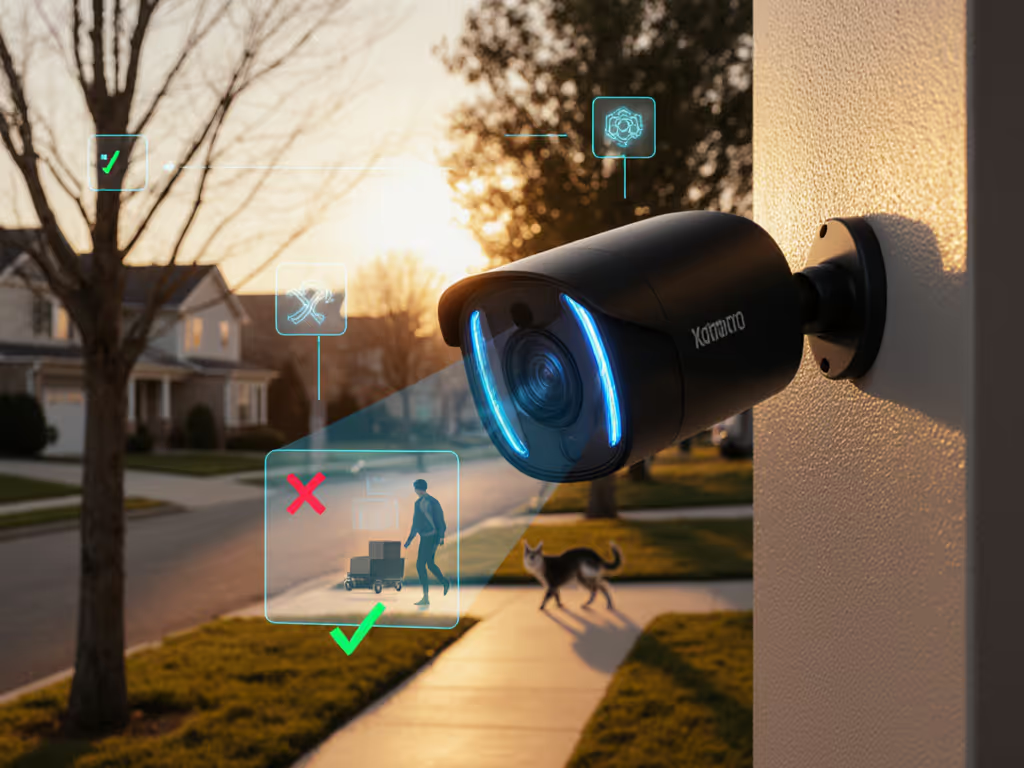
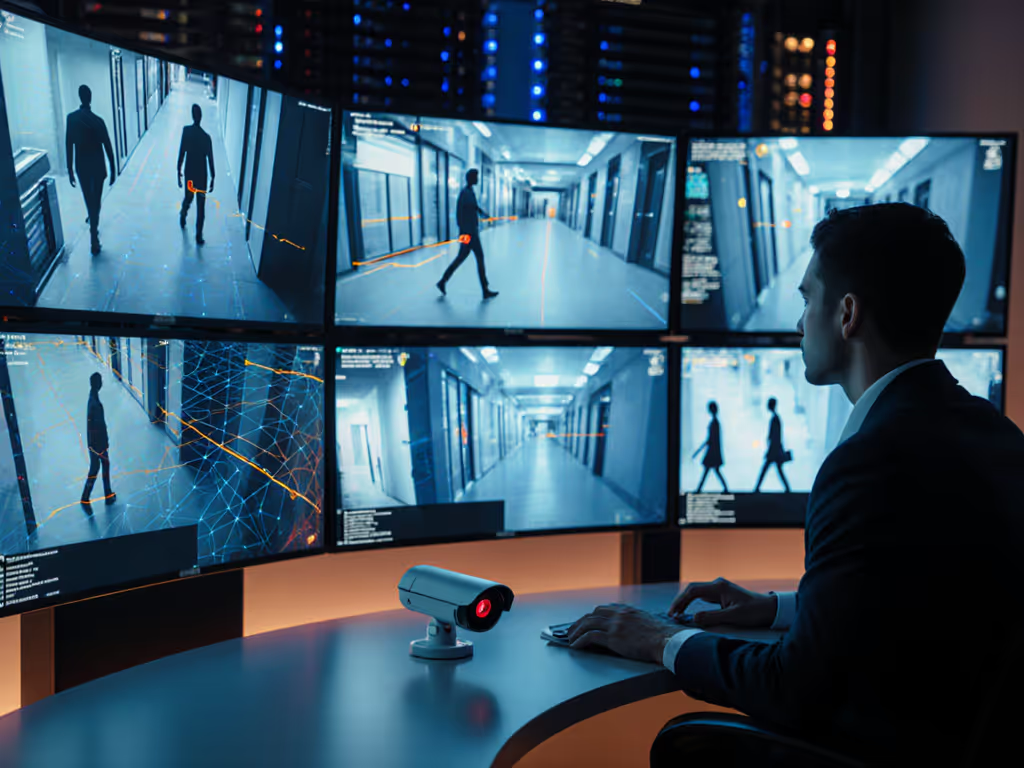
AI training security cameras represent a fundamental shift from basic motion detection to intelligent surveillance. These systems don't just see movement, they understand context, distinguishing between actionable threats and environmental noise. Similarly, security camera model training transforms raw pixels into reliable evidence by teaching neural networks to recognize patterns that matter when seconds count. I've evaluated countless systems where clarity plus context turns video into evidence when minutes matter most, and the difference between noise and notification starts with proper model training.
8 Critical Insights on AI Training for Security Cameras
1. Training Data Requirements for Real-World Performance
Security-specific AI models demand diverse, high-quality datasets that reflect actual deployment environments. Unlike generic object detection systems, effective security models require thousands of examples showing humans, vehicles, animals, and environmental factors (wind-blown debris, shadows, precipitation) across varying lighting conditions. The dataset requirements for security AI must include:
- Low-light and backlit scenarios where detail retention matters
- Multiple angles showing subjects at different distances
- Environmental challenges like rain, snow, and foliage movement
- Edge cases specific to urban vs. rural deployments
Without this comprehensive training data, systems generate excessive false triggers that erode user trust. I've seen cameras fail when their training data lacked representative nighttime footage, resulting in unidentifiable subjects when evidence mattered most.

2. Security-Specific Neural Network Architecture
General-purpose neural networks often fail in security applications due to mismatched priorities. Security-specific neural networks optimize for evidence framing rather than simple classification accuracy. These architectures prioritize:
- Temporal consistency across frames (reducing flickering detections)
- Stable bounding boxes that track subjects without erratic jumps
- Preservation of facial and license plate details in motion
- Minimal processing latency for timely notifications
Unlike consumer-grade models that prioritize speed over accuracy, professional security systems maintain higher computational budgets to ensure detections reflect reality. A one-second delay might mean missing the crucial frame that identifies a perpetrator.
3. Verification Methods Beyond Basic Detection
Simply identifying "a person" isn't sufficient for security applications. Effective AI training security cameras implement multi-stage verification:
- Initial motion detection at sensor level
- Primary object classification (human vs. animal vs. vehicle)
- Contextual analysis (time of day, location relevance)
- Behavioral assessment (loitering vs. passing through)
- Secondary verification (audio cues, cross-camera tracking)
This layered approach creates clear thresholds between nuisance triggers and genuine alerts. For a deeper dive into Video Content Analysis and how it reduces false alarm fatigue, see our guide. In a residential installation I evaluated, this methodology reduced false notifications from 15 daily to fewer than two weekly, a dramatic improvement that kept the homeowner engaged with their system rather than disabling alerts.
4. Continuous Learning with Controlled Adaptation
Static models quickly become obsolete as environments change. The most effective security camera model training incorporates controlled learning mechanisms that adapt to new patterns without compromising security:
- Distinguishing between legitimate environmental changes (new construction, seasonal foliage)
- Ignoring persistent false triggers (swaying branches, passing wildlife)
- Maintaining sensitivity to novel threats
- Preserving evidence integrity during adaptation
This dynamic capability proved decisive during the assessment of a retail system where the AI learned to ignore regular delivery trucks during business hours while maintaining sensitivity to nighttime activity. The result: 87% fewer false alerts with no compromise in actual threat detection.
5. Validation Protocols That Mirror Real Incidents
Theoretical accuracy metrics mean little when evidence must withstand scrutiny. AI model validation security requires testing against:
- Standardized challenge sets with known false-positive rates
- Real-world scenarios that replicate actual security incidents
- Time-sensitive response metrics (can the system trigger fast enough?)
- Evidence quality assessments (is the captured footage usable?)
Too many manufacturers publish detection accuracy statistics from ideal laboratory conditions that bear little resemblance to actual deployments. Objective failure notes from field testing reveal how systems perform when it matters, not just under perfect conditions.
6. Hardware-Software Co-Optimization for Evidence Quality
AI processing occurs most effectively at the edge when designed for evidence collection. Systems that merely push raw video to the cloud for analysis create unnecessary latency and privacy concerns. The best implementations optimize across the entire chain:
- Sensor quality that captures detail in critical lighting conditions
- On-device processing that maintains stable bitrates during motion
- Consistent frame timing that preserves temporal relationships
- Export formats that preserve forensic integrity
A recent installation for a property manager demonstrated this principle: cameras with proper edge processing delivered admissible evidence with readable license plates at 110 feet, while higher-resolution but poorly optimized systems created motion-blurred footage unusable for identification. To understand how resolution impacts identification range, see our 1080p vs 4K guide.
7. Avoiding Common AI Training Pitfalls
Many security implementations fail due to fundamental misunderstandings about AI capabilities:
- Overfitting to specific environments: Models trained on suburban homes struggle in urban settings
- Ignoring lighting dynamics: Daytime performance doesn't translate to nighttime reliability
- Prioritizing novelty over stability: Flashy features often compromise core detection capabilities
- Poor temporal resolution: Insufficient frames-per-second creates motion blur during critical events
Evidence over features means recognizing that a camera that reliably captures 720p footage with balanced exposure and clean audio will serve better than a 4K system producing unusable, motion-blurred clips during actual incidents. Dial in your detections using our motion detection calibration methods to cut noise without missing real events.
8. Setting Realistic Expectations for AI Capabilities
No system achieves 100% accuracy, and effective security camera model training acknowledges limitations. The most valuable implementations provide:
- Transparent false-positive/false-negative rates for specific scenarios
- Configurable sensitivity thresholds that match user risk tolerance
- Clear documentation of environmental limitations
- Evidence-based performance metrics from actual deployments
I recall a client who initially dismissed a system because it "missed" one in 200 deer crossings. Yet the same system never missed a human intruder over six months, a tradeoff that made perfect sense when viewed through the lens of evidence quality rather than theoretical perfection.
Final Verdict: Evidence Quality Trumps Detection Numbers
The value of AI training security cameras isn't measured in detection percentages alone, but in the reduction of response fatigue and increase in actionable intelligence. When security camera model training prioritizes evidence framing over novelty features, the result is fewer distractions during critical moments and higher-quality documentation when incidents occur.
Machine learning security applications reach their potential not through theoretical perfection, but through reliable, consistent performance that delivers usable evidence when needed. Systems that maintain color fidelity, minimize motion blur, and produce exportable footage with clear timestamps consistently outperform higher-specification but poorly calibrated alternatives.
Evidence over features isn't just a philosophy, it's the difference between video that documents an incident and video that resolves one. When evaluating security AI, prioritize systems that deliver clarity plus context, knowing that consistent, exportable footage wins disputes while saving time and resources.
For homeowners and business operators alike, the ultimate metric isn't how many alerts a system generates, but how confidently you can rely on those alerts when they arrive. That reliability stems from thoughtful AI training that prioritizes real-world evidence quality above all else.
Related Articles